تحدث مباشرةً مع مدير المبيعات لدينا قبل مغادرتك. يمكننا مساعدتك في تقييم السوق المستهدف، وفئة الأفلام، واحتياجاتك من العينات، وخطة التوريد الخاصة بـ OEM/ODM.
موزعو الأفلام والموزعون الرئيسيون
مركّبو طلاءات التلوين وطبقة الحماية من الصدمات (PPF)
TPU الأليفاتي مقابل TPU العطري (PPF): قائمة مراجعة الجودة للمشتري
TPU الأليفاتي مقابل TPU العطري (PPF): قائمة مراجعة الجودة للمشتري
جدول المحتويات
The Uncomfortable Truth About “Premium TPU PPF”
Chemistry always wins.
When I review a TPU PPF sample for a distributor, I do not start with the sales deck, the showroom gloss photo, or the “10-year warranty” badge; I start with the resin family, the yellowing mechanism, the adhesive behavior, the weathering data, and whether the supplier can explain what happens after 1,000 hours under UV-A 340 nm exposure. Why? Because the market is full of films that look expensive on day one and look tired after one summer.
Aromatic TPU PPF is not automatically trash. Let’s be fair.
But clear exterior automotive paint protection film is a brutal application: sunlight, road salt, acid rain, bird droppings, alkaline cleaners, petroleum residue, heat cycling from -20°C to 80°C, and installers stretching film around compound curves. If a buyer is sourcing clear PPF for hoods, bumpers, mirrors, door cups, and high-end full-body wraps, I would treat aromatic TPU as a cost-risk material unless the supplier can produce unusually strong lab evidence.
That is the hard line.
The primary keyword here is TPU PPF, but the buying decision is not really about the acronym. It is about whether your film stays clear, bonds cleanly, self-heals consistently, releases without residue, and does not force your dealer network into warranty fights.
Aliphatic TPU vs Aromatic TPU: The Chemistry Buyers Cannot Ignore
Aliphatic TPU and aromatic TPU differ mainly in the isocyanate structure used to build the polyurethane chain. Aromatic systems commonly involve structures linked to MDI or TDI chemistry, where aromatic rings can absorb light and participate in photo-oxidation. Aliphatic systems are typically associated with HDI, H12MDI, or IPDI chemistry, which is generally more color-stable under outdoor UV exposure.
That sounds academic.
It is not.
A 2023 Royal Society of Chemistry paper hosted by MIT reported that polyurethane yellowing is commonly tied to oxidation of aromatic isocyanate residues into monoquinone imide and diquinone imide structures after UV exposure, with yellowing observed after a cumulative UV dose of 175 MJ/m² in the study’s photo-weathering setup: MIT-hosted polyurethane weathering research.
That is the smoking gun for buyers.
If the yellowing mechanism is built into the chemistry, then “more UV absorber” is not a magic shield. UV absorbers and HALS packages can delay visible failure. They can improve early test performance. They can help a mid-grade film survive a brochure test. But they do not rewrite the polymer backbone.
Here is my controversial opinion: if a supplier refuses to state whether its clear TPU PPF is aliphatic or aromatic, assume the answer is commercially inconvenient.
The Buyer’s Comparison Table
Quality Factor
Aliphatic TPU PPF
Aromatic TPU PPF
What Buyers Should Demand
UV yellowing resistance
Stronger baseline color stability under outdoor exposure
Higher yellowing risk under sunlight and oxygen
QUV-A 340 nm or xenon arc aging data, not just “anti-yellowing” wording
Typical chemistry
HDI, H12MDI, IPDI-based TPU systems
MDI or TDI-related aromatic systems
Resin declaration or supplier-side material confirmation
Lower-cost or less UV-demanding applications, sometimes colored or indoor films
Match chemistry to warranty length and climate
مخاطر الضمان
Lower risk if adhesive, coating, and processing are also controlled
Higher risk if sold as long-life clear exterior PPF
Written exclusion list, claim process, batch traceability
Visual aging
Lower Δb* shift when formulation is honest
More likely yellow/brown shift over time
CIE Lab* before/after reports and ΔE values
Price behavior
Higher raw material cost
Lower raw material cost
Compare landed cost against claim rate, not roll price
Red flag
Supplier hides coating or adhesive weaknesses behind “aliphatic” claim
Supplier sells “non yellowing TPU film” with no aging data
Ask for test reports by batch, not generic lab screenshots
Why Cheap TPU PPF Becomes Expensive After Installation
Roll price lies.
A distributor may save USD 20–60 per roll on a lower-cost TPU PPF and still lose thousands when installers begin reporting haze, adhesive lines, edge lift, premature yellowing, or inconsistent self-healing. The first return is annoying. The tenth return becomes a brand problem.
I have seen buyers obsess over 1.52 m × 15 m or 1.52 m × 30 m roll pricing while ignoring the two questions that actually matter: what happens after heat, stretch, soap, squeegee pressure, and six months of UV? And who pays when the answer is ugly?
According to the 2025–2030 paint protection film market report by MarketsandMarkets, the PPF market is projected to grow from USD 1,092.7 million in 2025 to USD 1,549.4 million by 2030, at a 7.2% CAGR: Paint Protection Films Market Report 2025–2030. Growth attracts serious factories. It also attracts opportunists.
For a serious buyer, “premium TPU PPF” should mean a testable specification package, not a mood. Keentop’s wider مجموعة منتجات أفلام النوافذ وأغشية حماية الطلاء (PPF) is a useful internal reference point because buyers can compare clear PPF, color PPF, windshield protection film, nano ceramic window film, and other surface protection categories instead of treating every roll as the same material with a different label.
The Quality Checklist I Would Use Before Buying TPU PPF
1. Demand Resin-Type Disclosure
Ask the supplier a direct question: Is the clear TPU layer aliphatic TPU, aromatic TPU, or a blended system?
Do not accept “TPU from famous brand” as an answer. TPU is a polymer family, not a quality grade. A buyer needs the resin type, basic thickness range, formulation intent, and whether the anti-yellowing performance comes from the backbone, the additive package, the topcoat, or a combination.
For clear exterior PPF, I would push for aliphatic TPU PPF unless the application is short-term, price-sensitive, or not heavily exposed to UV.
2. Get Real Weathering Data, Not Pretty Words
Ask for QUV or xenon aging reports with test method, duration, lamp type, irradiance, black panel temperature, humidity cycle, and before/after optical data.
Useful signals include:
UV-A 340 nm exposure
ASTM G154 or ISO 4892-3 style accelerated aging
CIE Lab* color measurement
ΔE and Δb* values after aging
60° gloss retention
Haze percentage
Tensile strength and elongation after exposure
If a supplier gives only “passed 3,000 hours” with no conditions, I treat that number as decoration.
3. Cut the Film and Measure the Stack
A proper TPU PPF stack usually involves a clear coat, TPU substrate, pressure-sensitive adhesive, and release liner. Buyers should check total thickness and functional-layer consistency.
Common buyer targets include:
Finished film thickness around 6.5–8.0 mil, or roughly 165–200 μm
Clear coat consistency across the web
Adhesive layer uniformity
Stable release force
No fisheyes, gels, die lines, or orange peel under inspection lighting
A film can feel thick and still fail. Thickness is not quality by itself.
4. Abuse the Adhesive Before Your Customers Do
Adhesive is where many PPF brands quietly bleed money.
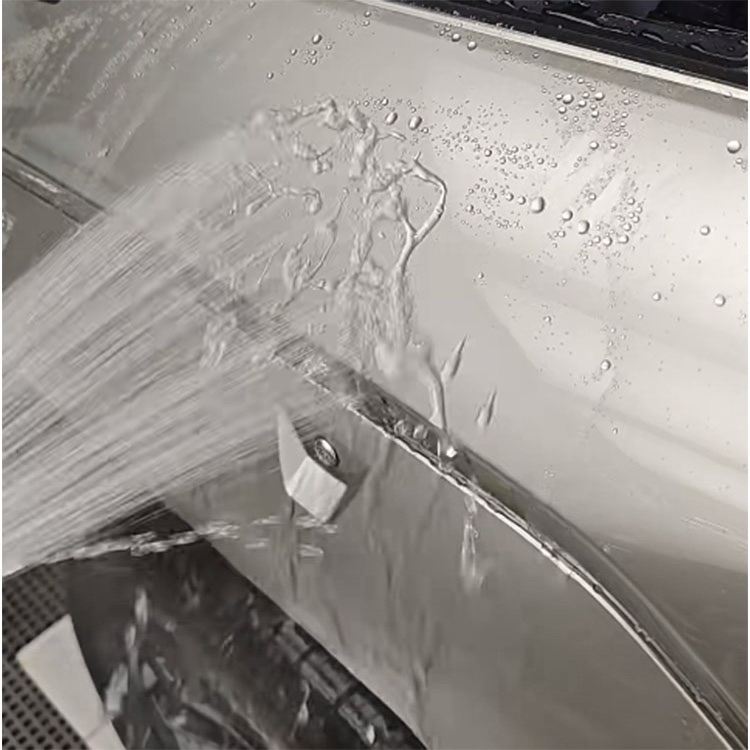
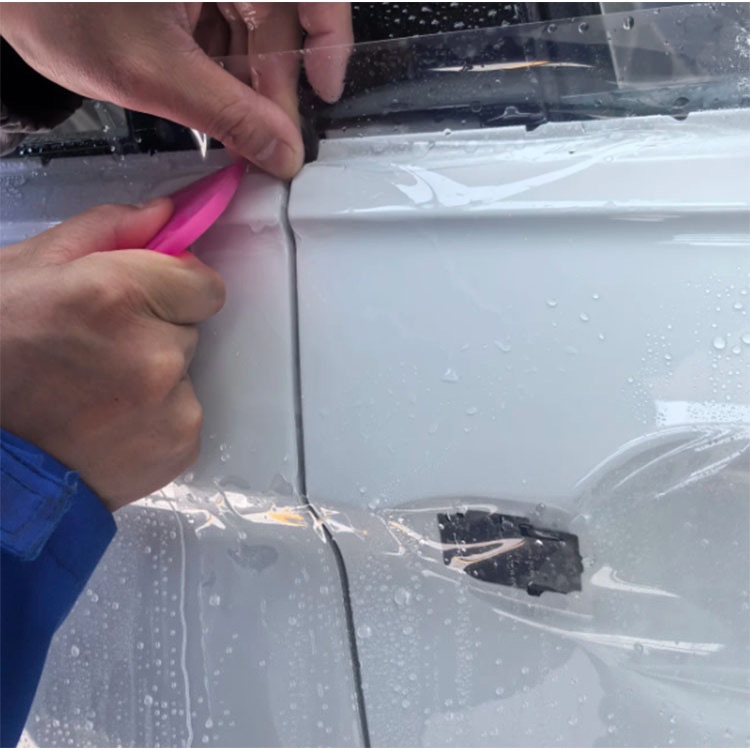
A good TPU PPF adhesive should allow repositioning during installation, hold edges after curing, resist whitening, and remove cleanly when handled correctly. Ask for tack, peel, release, and residue behavior. If you are building a distributor program, read Keentop’s own technical discussion on PPF adhesive tack, release, and residue limits before negotiating specs.
The warranty nightmare is not always yellowing. Sometimes it is glue ghosts on a black hood.
5. Test Self-Healing Like a Skeptic
Self-healing is often oversold.
Ask whether the coating heals fine swirl marks under sunlight, warm water, or heat gun assistance. Then test it with controlled abrasion. Do not let a supplier demonstrate only one perfect scratch under one perfect lamp.
A practical test:
Use a nylon brush or controlled micro-scratch pad.
Inspect under LED and sunlight.
Apply 50–60°C warm water.
Recheck after 5 minutes, 30 minutes, and 24 hours.
Compare gloss and haze before and after.
A film that “heals” but leaves haze is not premium. It is theater.
6. Check High-Visibility Finishes Separately
Clear PPF hides some sins. Black film exposes them.
For buyers sourcing color, gloss black, or piano-black film, the tolerance should be much tighter because dark surfaces reveal swirl marks, haze, adhesive texture, and coating defects faster than white or silver paint. Keentop’s article on piano black PPF scratch-and-swirl specs is worth reading before applying clear-film assumptions to black finishes.
I would not buy piano black PPF from a supplier who cannot discuss gloss units, orange peel, micro-scratch visibility, and coating hardness in the same conversation.
The Warranty Trap: When “10 Years” Means Almost Nothing
Here is where buyers get lazy.
A supplier says “10-year warranty,” and everyone relaxes. But what exactly is covered? Yellowing? Cracking? Delamination? Adhesive residue? Staining? Loss of gloss? Labor? Replacement film only? Does coverage apply in Dubai, Florida, Mexico, Australia, and Saudi Arabia equally? Is there a batch number? Is installer error excluded so broadly that the warranty becomes decorative?
The U.S. Federal Trade Commission’s Businessperson’s Guide to Federal Warranty Law reminds companies that warranties need clear terms, exclusions, and disclosure practices under the Magnuson-Moss Warranty Act framework: FTC Businessperson’s Guide to Federal Warranty Law.
That matters even outside the U.S. because serious distributors borrow the same discipline: clear warranty scope, written claim process, batch traceability, and no fantasy language.
A serious TPU PPF warranty should state:
Coverage term by product grade
Covered defects
Excluded chemicals and misuse
Climate or region limitations
Installer requirements
Batch number documentation
Labor responsibility
Replacement procedure
Required photo or sample evidence
Time limit for claims
If the warranty is shorter than the sales pitch, trust the warranty.
How to Choose TPU PPF Without Getting Played
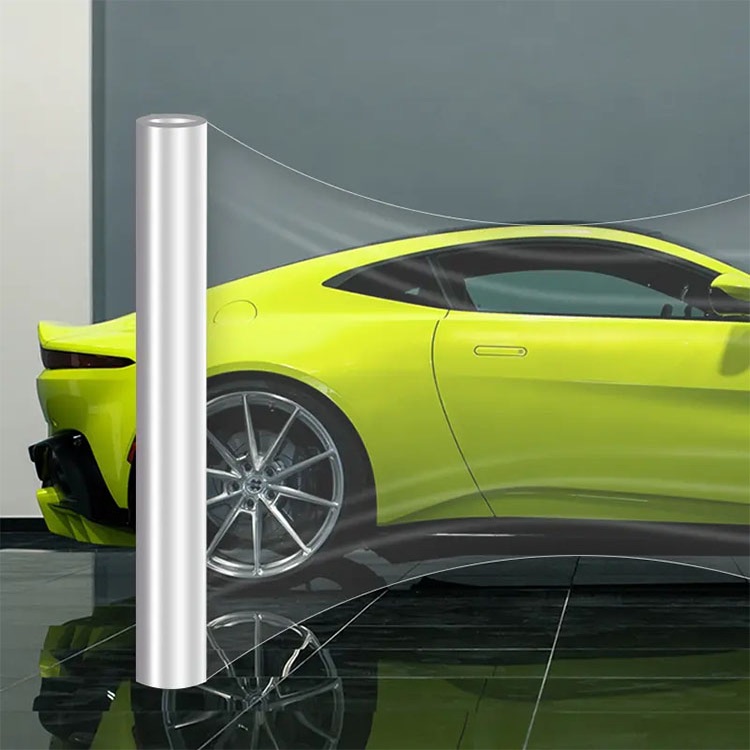
The best TPU PPF for cars is not the glossiest sample on a black display panel. It is the film that performs across resin stability, optical clarity, coating recovery, adhesive control, weathering resistance, batch consistency, and supplier accountability.
For clear exterior automotive use, I would rank buyer priorities like this:
Aliphatic TPU chemistry for better non yellowing TPU film performance
Verified UV aging and color-shift data
Clean adhesive removal and stable edge behavior
Optical clarity with low haze and controlled orange peel
Repeatable self-healing under realistic heat
Batch traceability and written warranty terms
OEM/ODM supply support for packaging, market testing, and reorder stability
If you are building a private-label PPF program, the supplier’s operational structure matters almost as much as the roll. A factory positioned as an OEM/ODM film manufacturer for PPF and window film can support sample confirmation, packaging coordination, flexible MOQ, and product matching better than a reseller who only moves boxes.
And for color film buyers, do not ignore ΔE, gloss, and UV stability. Keentop’s Color PPF Procurement Rules of 2026 is exactly the kind of internal technical content that belongs next to procurement conversations, because color shift is not an aesthetic footnote. It is a warranty trigger.
Red Flags That Tell Me a TPU PPF Supplier Is Hiding Something
Some warning signs are subtle. Others scream.
Run if you see these:
The supplier will not say aliphatic or aromatic.
The sample has no batch code.
The warranty file is one vague PDF page.
“Anti-yellowing” appears with no test method.
The adhesive feels aggressive immediately but lifts at edges after stretch.
The film smells strongly of solvent or has visible coating marks.
The supplier avoids hot-weather markets in references.
The price is far below competing aliphatic TPU PPF offers.
Test reports show no lab name, date, method, or sample ID.
The sales team says “same as famous brand” instead of showing data.
My rule is simple: if the supplier cannot explain failure modes, they cannot control them.
الأسئلة الشائعة
ما هو فيلم حماية الطلاء (TPU PPF)؟
TPU PPF is a transparent thermoplastic polyurethane paint protection film applied over vehicle paint to resist stone chips, wash marring, stains, UV exposure, and daily road debris while preserving gloss, color, and resale value for dealerships, installers, distributors, and private-label buyers sourcing rolls in bulk. It usually includes a topcoat, TPU substrate, adhesive, and release liner.
A strong TPU PPF should combine optical clarity, elastic recovery, adhesive stability, hydrophobic behavior, and yellowing resistance. The weak products usually fail in one of those layers, not always in the TPU itself.
What is the difference between aliphatic TPU PPF and aromatic TPU PPF?
Aliphatic TPU PPF uses more UV-stable non-aromatic polyurethane chemistry, while aromatic TPU PPF uses aromatic structures that can be more vulnerable to sunlight-driven oxidation and visible yellowing, especially in clear exterior automotive films exposed to UV, oxygen, heat, humidity, and aggressive cleaning chemicals. This is why premium clear PPF buyers usually ask for aliphatic TPU.
Aromatic TPU can still have value in lower-cost or less UV-exposed applications. But if the target is long-life clear automotive paint protection film, buyers should demand proof before accepting aromatic chemistry.
Why does PPF turn yellow?
PPF turns yellow when polyurethane chemistry, UV exposure, oxygen, heat, topcoat breakdown, adhesive aging, or contamination causes visible color shift, often measured through Δb* or ΔE changes in CIE Lab* color space after weathering tests. In aromatic polyurethane systems, photo-oxidation can create yellow chromophore structures.
Bad installation chemicals can make the problem worse. So can poor maintenance, harsh degreasers, low-grade adhesive, and weak topcoat design.
How do I choose the best TPU PPF for cars?
The best TPU PPF for cars is a film with verified aliphatic TPU chemistry, low haze, strong gloss retention, controlled adhesive behavior, reliable self-healing, clean removability, UV aging data, and written warranty terms tied to batch traceability. Buyers should compare lab data, not just roll price or sample shine.
A good buyer should test at least three rolls from a pilot batch before scaling. One hand sample is not enough.
Can aromatic TPU PPF be sold as non yellowing TPU film?
Aromatic TPU PPF can be marketed with anti-yellowing additives, UV absorbers, HALS packages, or protective coatings, but buyers should be skeptical when it is sold as long-life non yellowing TPU film for clear exterior automotive use without weathering data. Additives may delay yellowing, but they cannot fully erase chemistry risk.
If the film is colored, short-term, indoor, or used in a lower-exposure market, the decision may be different. Clear hood film in high-UV markets is not forgiving.
What test reports should a TPU PPF buyer request?
A TPU PPF buyer should request accelerated UV aging, CIE Lab* color shift, haze, gloss, tensile strength, elongation, peel adhesion, release force, stain resistance, chemical resistance, self-healing, and residue-removal reports that include dates, methods, sample IDs, and batch references. Generic “passed” claims are not enough for serious procurement.
The strongest suppliers can connect the test report to the actual production batch. That is the difference between marketing and quality control.
Final Thoughts: Make the Supplier Prove the Film Before You Buy the Roll
Do not buy TPU PPF on adjectives.
Buy it on chemistry, test reports, adhesive control, optical data, batch discipline, and warranty language. If you are comparing aliphatic TPU PPF vs aromatic TPU PPF, the decision should not be emotional: clear exterior automotive film needs color stability, and aliphatic chemistry has the better starting position.
Before your next bulk order, ask your supplier for resin confirmation, UV aging data, ΔE/Δb* color shift, adhesive test results, self-healing proof, and a written warranty that says exactly what happens when a customer files a claim.
If you are building or upgrading a PPF line, review Keentop’s TPU PPF product category and send your target market, roll size, packaging needs, and expected volume for a sample-based quality comparison before committing to full-scale procurement.