Top Automotive Film Supplier and OEM/ODM Manufacturer – KeenTop
Top Automotive Film Supplier and OEM/ODM Manufacturer – KeenTop Built for B2B: stable supply, flexible customization, and technical support across PPF, automotive window films, architectural films, and industrial valves—helping partners improve delivery efficiency and ROI.
PreCut PPF Kit Ecosystem Growth and Supplier Licensing Risks-2026
PreCut PPF Kit Story.I watched an installer lose access to his entire pattern database in 72 hours. Not because he did anything wrong — because the software platform his supplier was licensed through changed its regional distribution terms, and his access got caught in the restructuring. Three years of vehicle-specific templates. Gone. Every pre-cut job he had booked for the following month had to be hand-cut or cancelled.
Nobody warned him this was possible. Nobody told him the patterns weren’t really his.
That’s the conversation the pre-cut PPF kit industry needs to have — and almost never does.
Table of Contents
Why PreCut PPF Kit Took Over the Installation Market
The shift happened faster than most people in the industry expected. Five years ago, bulk film rolls and hand-cutting dominated professional PPF installation. Skilled installers treated their cutting ability as a competitive differentiator. Then pre-cut kits started eating that advantage from both ends — reducing the skill barrier for new installers while simultaneously cutting installation time by 40–60% on common vehicle patterns, which compressed margins on hand-cut work to the point where it stopped making economic sense.
The math is straightforward and brutal. A skilled installer hand-cutting a full front-end package on a mid-size SUV might take 4–6 hours. A trained technician using a quality pre-cut PPF kit from a well-maintained pattern database does the same job in 90–120 minutes. At any reasonable labor rate, that time differential is the difference between a profitable job and a break-even one. So the market moved. Fast.
According to Reuters’ 2023 automotive aftermarket supply chain coverage, the broader automotive protective film sector grew at a compound annual rate exceeding 8% between 2021 and 2023, with the pre-cut and kitted format segment outpacing bulk film growth by a significant margin in North American and European markets. That’s not a niche trend. That’s a structural market shift that’s still accelerating.
But growth creates complexity. And the complexity in the pre-cut PPF kit ecosystem isn’t in the film — it’s in the intellectual property layer sitting underneath it.
The Ecosystem Nobody Explains at the Point of Sale
Here’s the ugly truth about how pre-cut PPF kit systems actually work. When an installer buys into a pre-cut program — whether through a distributor, a software subscription, or a bundled film-plus-patterns arrangement — they’re typically accessing a three-layer ecosystem: the film itself, the cutting software or plotter integration, and the pattern database. Those three layers are almost never owned by the same entity. And the licensing arrangements between them are almost never disclosed clearly at the point of sale.
The film supplier might be one company. The cutting software — DAP, Flexi, or a proprietary platform — is typically a separate entity with its own licensing structure. The pattern database might be owned by a fourth party entirely, with regional exclusivity clauses, minimum volume commitments, and termination provisions that none of the downstream buyers have read. That’s not a conspiracy. It’s just how these ecosystems assembled themselves as the market grew faster than anyone standardized the commercial arrangements.
The risk surface for an installer or distributor sitting at the bottom of this stack is real and underappreciated. If any upstream licensing arrangement changes — platform acquisition, regional distributor restructuring, minimum volume non-compliance, or straight-up IP dispute — the pattern access that the installer’s business model depends on can be restricted or revoked without the installer having any contractual recourse.
I’ve seen this happen more than once. And I frankly believe the industry’s reluctance to talk about it openly is because too many distributors and software platforms benefit from the opacity.
Intellectual Property in PPF Patterns: What Actually Gets Protected
This is where it gets legally specific, and where most people’s eyes glaze over — which is exactly when they should be paying attention.
Vehicle-specific PPF cutting patterns sit at an interesting intersection of copyright and trade secret law. The pattern itself — a precise digital template mapped to a specific vehicle’s panel geometry — can be protected as a creative work under copyright if it meets the originality threshold, or as a trade secret if the holder can demonstrate it derives commercial value from not being generally known. In practice, major pattern database operators pursue both protections simultaneously.
A 2023 intellectual property analysis published by the Stanford Law School Center for Internet and Society examined the enforceability of digital template licensing restrictions in the automotive aftermarket context and found that downstream users — the installers and small distributors — rarely have the contractual standing to challenge upstream IP ownership changes, even when those changes directly affect their access to tools they’ve paid to use. The precedent in software licensing generally favors the platform, not the end user, when distribution arrangements change.
What does that mean practically? If a major PPF pattern database operator is acquired — which has happened in this market — the acquiring entity can restructure regional licensing arrangements, impose new minimum volume requirements, or simply discontinue support for certain plotter integrations. Installers who built their workflow around those patterns have no protected right to continued access, regardless of what they paid upfront.
And the exposure isn’t hypothetical. Bloomberg’s coverage of intellectual property disputes in the automotive software sector through 2023–2024 documented an increase in licensing restructuring events across automotive aftermarket platforms as private equity consolidation accelerated in the sector. PPF pattern databases are not immune to that dynamic.
How to Vet a Pre-Cut PPF Supplier Before You’re Locked In
So what does responsible supplier selection look like for an installer or distributor who wants to build a business on pre-cut kits without inheriting someone else’s IP risk?
Start with ownership clarity. Before signing any distribution or program agreement, ask directly: who owns the pattern database you’ll be accessing? Is the cutting software proprietary to the film supplier, or licensed from a third party? What happens to your pattern access if the supplier’s licensing arrangement with the software platform changes? If those questions produce vague answers or deflection, that’s your risk signal.
Then look at the film layer independently of the software layer. A supplier who can offer quality TPU clear paint protection film in roll format alongside pre-cut kit access gives you optionality — if the pattern database becomes inaccessible, you still have a film supply relationship and the ability to hand-cut or access an alternative pattern source. Suppliers who bundle film access exclusively with a proprietary software ecosystem are creating dependency by design.
Check the termination provisions. Specifically: what triggers termination of pattern access, what notice period is required, and what rights — if any — do you retain to patterns you’ve already downloaded or jobs you’ve already quoted? Those clauses will tell you more about the real risk allocation than any sales presentation.
And honestly? Ask for references from installers who’ve been in the program for more than three years. Not new customers — long-term users who’ve lived through at least one platform update cycle or distributor restructuring. Their experience is the most reliable signal you have about how the supplier actually behaves when commercial arrangements get complicated.
Open software + licensed patterns (e.g., DAP or Flexi + third-party DB)
Database operator
Medium — depends on DB operator stability
Medium — film sourced separately
Medium — software portable, DB may not be
Film supplier with optional pre-cut service
Installer retains cut files
Low — patterns generated per job
High — film sourced independently
Low — no lock-in structure
Distributor-branded kit program
Varies — often undisclosed
Medium-High — upstream IP unclear
Medium
Medium — depends on distributor stability
Direct manufacturer with in-house pattern library
Manufacturer-owned
Low-Medium — stable if manufacturer is stable
High — direct supply relationship
Low — direct contract
The pattern that holds across high-risk models: opacity about who actually owns the IP, combined with bundling that makes film access conditional on platform participation. That combination is where the real exposure sits.
The Film Quality Variable Nobody Separates From the Kit Question
Here’s a point I feel strongly about, and one the industry consistently muddles: the quality of the pre-cut kit and the quality of the film inside it are completely separable variables, and conflating them is how buyers end up over-paying for mediocre film packaged in a sophisticated-looking ecosystem.
A pre-cut kit is a delivery format. The film is the product. And a precisely cut template of a poorly formulated TPU PPF still installs a poorly formulated film — it just installs it faster. The self-healing performance, UV resistance, elongation at break, and top coat stability of the film itself are unaffected by how precisely it was cut before it arrived at the shop.
Buyers who evaluate pre-cut kit programs primarily on pattern database size, vehicle coverage, or software interface quality — and skip the film TDS entirely — are selecting on the wrong variable. The pattern database gets you through the installation. The film chemistry determines what happens to the client’s vehicle over the next seven years.
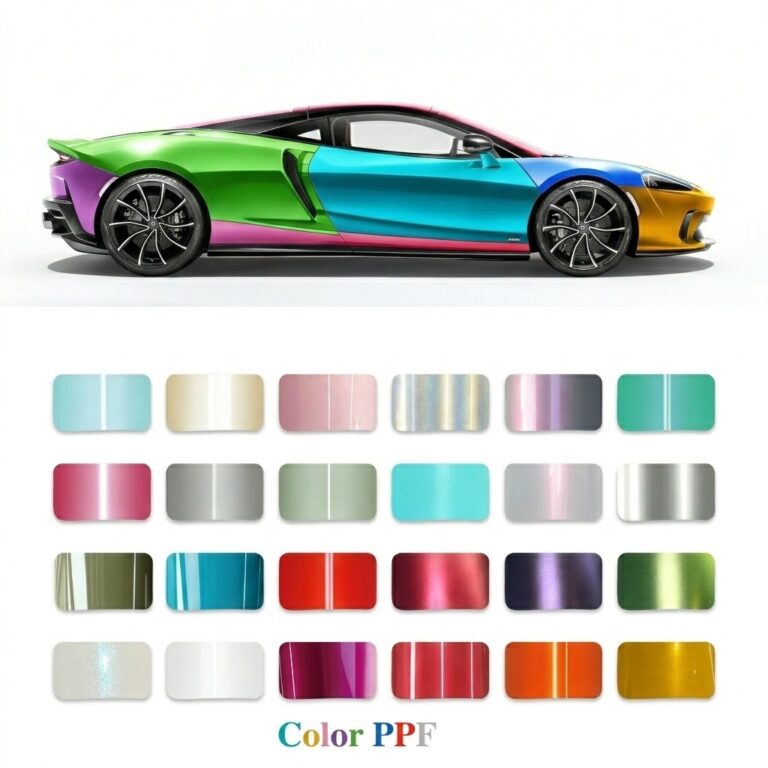
For clients specifying color options specifically, the same logic applies to color PPF film and specialty finishes like piano black paint protection films — the kit format is irrelevant if the base film formulation can’t maintain optical stability in those finishes across a reasonable service life. Ask for the TDS on the specific film inside the kit. Not the kit brochure. The film’s actual data sheet.
Frequently Asked Questions
What is a pre-cut PPF kit? A pre-cut PPF kit is a vehicle-specific package of paint protection film panels that have been precision-cut using digital pattern software to match exact panel dimensions for a particular vehicle make, model, and year, allowing installers to apply film without hand-cutting from bulk rolls — significantly reducing installation time and skill requirements compared to traditional bulk film installation methods.
The kit is a format, not a film specification. Quality varies entirely based on the film formulation inside the kit, not the precision of the cut.
What are the licensing risks of pre-cut PPF supplier programs? Pre-cut PPF supplier licensing risks arise from the multi-layer IP structure underlying most kit ecosystems, where the film supplier, cutting software platform, and pattern database are frequently owned by different entities with separate licensing arrangements — meaning that changes at any upstream layer (acquisition, regional restructuring, minimum volume changes) can restrict or revoke an installer’s pattern access without contractual recourse for the downstream buyer.
The practical exposure: an installer whose business model depends on a specific pattern library can lose access to that library through upstream IP events entirely outside their control.
How do I choose the best pre-cut PPF supplier? Choosing the best pre-cut PPF supplier requires evaluating three independent variables: first, film quality — request the TDS and verify aliphatic TPU base, elongation at break above 380%, and UV yellowing resistance data; second, IP ownership clarity — confirm who owns the pattern database, what triggers termination of access, and what rights you retain if the arrangement changes; third, supply flexibility — verify whether film access is conditional on platform participation or available independently.
Suppliers who can’t clearly answer the IP ownership questions are the ones whose licensing structures present the highest downstream risk.
Can PPF cutting patterns be legally protected? PPF cutting patterns can be legally protected under copyright law as original creative works if they meet the applicable originality threshold, or as trade secrets if the owner can demonstrate the patterns derive commercial value from not being publicly known — and major pattern database operators in the PPF industry typically pursue both protections simultaneously to maximize enforcement options against competitors and unauthorized use.
Downstream installers and distributors rarely have contractual standing to challenge upstream IP ownership changes that affect their access.
What happens to my pattern access if my PPF supplier changes its licensing terms? If a PPF supplier changes its licensing terms — through acquisition, platform restructuring, or distributor agreement modification — installer pattern access can be restricted, modified, or terminated based on the new terms, with the installer having limited recourse unless their original contract included explicit protections for continued access, minimum notice periods, and retained rights to previously downloaded pattern files.
This is the single most underread section of PPF kit program agreements. Read the termination and access clauses before you commit.
Should I evaluate the film separately from the pre-cut kit program? Yes — always evaluate the film TDS independently of the kit program’s software and pattern features, because the cutting format affects installation efficiency while the film chemistry determines protection performance, UV stability, self-healing capability, and long-term optical clarity across a 7–10 year service life. A precisely cut kit built around a poorly formulated film is a fast path to a badly performing installation.
If you’re currently evaluating pre-cut PPF kit suppliers — or trying to understand the licensing structure of a program you’re already in — drop your specific situation in the comments. Supplier model, how long you’ve been in the program, and what your pattern access terms look like. I’ll give you a direct read on where your exposure sits.