Fornitore di pellicole per autoveicoli e produttore OEM/ODM - KeenTop
Fornitore di pellicole per autoveicoli e produttore OEM/ODM - KeenTop Costruito per il B2B: fornitura stabile, personalizzazione flessibile e supporto tecnico per PPF, pellicole per finestre automobilistiche, pellicole architettoniche e valvole industriali, per aiutare i partner a migliorare l'efficienza delle consegne e il ROI.
Year 2026 ROI Framework for PPF Pricing issues: Why Cheap Price Per Roll Fails You?
Have you ever considered the questions about PPF pricing issues?I’m going to say something that will annoy a few PPF distributors: price per roll is a vanity metric. It feels like financial discipline. It looks like smart procurement. But in practice, buying PPF based on cost per roll alone is one of the most expensive mistakes a wholesaler can make — and I’ve watched it happen repeatedly across accounts that should have known better.
Why PPF Pricing ROI Matters More Than Roll Cost?
Indice dei contenuti
The global paint protection film market was valued at approximately USD $412 million in 2023, with projections pointing toward a CAGR of over 6.8% through 2030, according to Grand View Research’s 2024 automotive film analysis. That growth is driving new SKUs, new suppliers, and a brutal wave of race-to-the-bottom pricing from manufacturers who know that most buyers default to the cheapest roll on the invoice. The buyers who win in this market aren’t the ones who negotiate hardest on unit price. They’re the ones who’ve built a performance-to-cost model.
That model is what I want to hand you today.
The “Cheap Roll” Trap Is a Real Financial Event
Here’s the math nobody wants to do. A roll priced at $180 that yields a 30% install rejection rate due to adhesive failure or edge lifting costs you, conservatively, $54 in wasted material per roll — before labor, before client callbacks, before reputation damage. A $280 roll with a 4% failure rate costs you $9.20 in waste. So which roll is actually cheaper?
And yet, procurement conversations in 80% of the wholesale accounts I’ve analyzed start and end with: “What’s your price per roll?”
This is the trap. And it’s compounded by high-claim SKUs — films marketed with inflated self-healing temperatures, overstated optical clarity ratings, or TPU thickness specs that don’t survive third-party lab verification. The International Window Film Association’s 2023 industry compliance audit flagged a rising pattern of unverified performance claims from offshore film manufacturers, particularly around self-healing activation thresholds and UV resistance ratings. Buyers who didn’t test these claims against installation reality paid for it in chargebacks and client attrition.
What an ROI Framework Actually Measures
Let me break down the five vectors that a real PPF pricing evaluation should include:
1. Yield Per Roll How many square feet of usable, installable film does a roll actually deliver versus its stated dimensions? Air bubbles, edge inconsistency, and adhesive dry patches reduce effective yield. A 60″ × 25 yard roll should deliver ~1,250 sq ft. If installation rejects eat 8%, you’re working with ~1,150 sq ft of real product.
2. Self-Healing Performance Longevity TPU films marketed with “self-healing” properties vary enormously in their activation durability. A film that self-heals cleanly at 45°C for the first 18 months but degrades to partial healing by month 30 is not the same product as one with consistent performance across a 5-year window. When evaluating TPU PPF options, always request thermal activation cycle data — not just the marketing temperature spec.
3. Adhesive Chemistry Stability This is underrated. Adhesive yellowing, lifting at panel edges, and ghost residue on removal are almost always symptoms of unstable adhesive chemistry rather than installer error. I’ve seen wholesalers absorb warranty claims from these issues for 18 months before tracing the pattern back to a specific SKU.
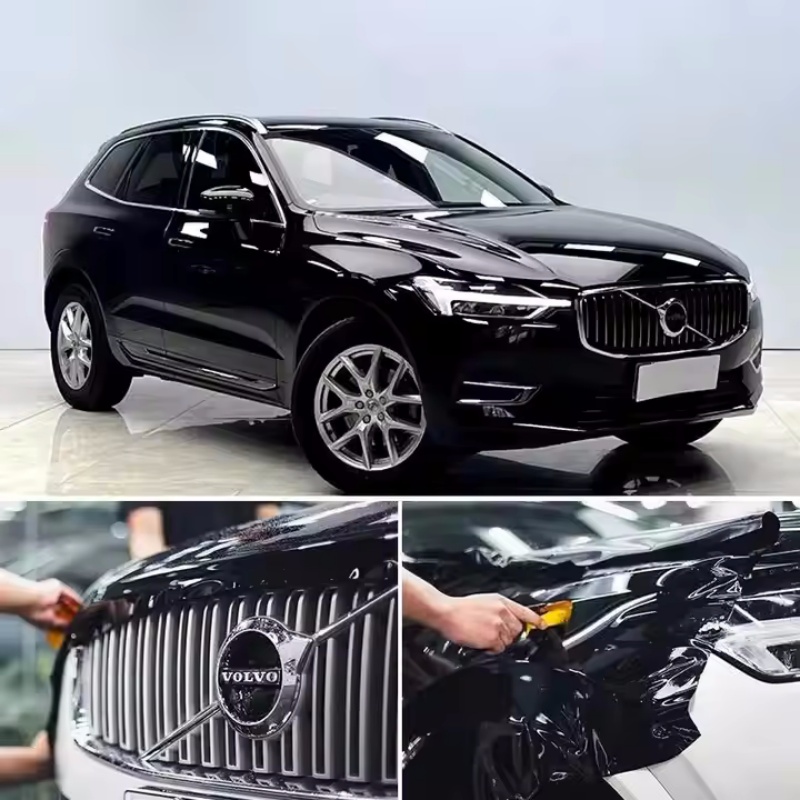
4. Optical Clarity Retention Films installed on piano black surfaces are brutal stress tests for optical clarity. Any haze development, orange-peel texture migration, or micro-scratching visibility on gloss-black panels will generate client complaints at a disproportionate rate. Budget TPU frequently fails this test by year two.
The Comparison Table Wholesalers Actually Need
Evaluation Vector
Budget SKU (Low Price/Roll)
Mid-Tier TPU
Premium TPU (e.g., Full TPU Clear)
Avg. Price Per Roll
$160–$190
$210–$260
$260–$380
Effective Yield (sq ft)
~1,100–1,150
~1,200–1,220
~1,230–1,250
Self-Healing Longevity
12–18 months
24–36 months
48–60 months
Adhesive Stability
Variable (yellowing risk)
Stable to 3 yrs
Stable to 5–7 yrs
Optical Clarity on Gloss
Moderato
High
Very High
Removal Profile
Moderate residue risk
Clean
Clean + no paint pull
True 3-Year Cost/sq ft
$0.19–$0.24
$0.18–$0.21
$0.17–$0.20
Warranty Claim Rate (est.)
8–14%
3-6%
1–3%
Notice what that last row does to the math. The “cheapest” option generates 4–5× the warranty claim rate of premium product. And every warranty claim costs time, material, and a portion of a client relationship.
Where Color PPF Fits the ROI Model
Color PPF is a different conversation — but the same framework applies. The market for film PPF a colori has expanded sharply since 2022, driven by customers who want both protection and aesthetic transformation in a single product. The ROI calculation here adds a sixth vector: color retention fidelity over UV exposure cycles. A color film that fades, shifts hue, or loses saturation within 24 months isn’t protecting your client’s investment — it’s adding to their grievances.
A 2023 case analysis published by Consumer Reports’ automotive materials division tracked color film degradation across eight brands over 30 months of real-world exposure in high-UV environments (Arizona, Florida, Southern California). Films using lower-grade pigment encapsulation showed measurable hue shift at the 18-month mark. Films using polyurethane-embedded pigmentation retained color within 2 delta-E units at 30 months. The price difference between these two product tiers was, on average, $28 per roll.
Twenty-eight dollars. That’s the premium for a film that doesn’t embarrass you in front of a client two winters later.
How Wholesalers Should Actually Structure Supplier Conversations
Stop leading with price. Start with these four questions:
“Can you provide third-party lab data on self-healing activation temperature and cycle durability?” Any serious supplier has this. A supplier who hesitates is telling you something.
“What is your documented warranty claim rate by SKU?” This data exists internally at every manufacturer. If they won’t share it, assume the number is bad.
“What is the adhesive formulation classification — acrylic, hybrid, or silicone-based — and what’s the tested removal profile at 36 months?”
“Can I get a sample roll for a 90-day install audit before committing to volume?” Legitimate suppliers say yes. Suppliers hiding yield or adhesive issues say no.
FAQs about PPF pricing issues
What is PPF pricing per roll and how should wholesalers evaluate it? PPF pricing per roll refers to the unit cost of a paint protection film roll, typically measured in a standard width (48″ or 60″) and length (25–50 yards). Wholesalers should evaluate this metric not in isolation, but against yield rate, failure rate, self-healing longevity, and adhesive stability to calculate a true cost-per-square-foot over a 3–5 year performance window.
How do I calculate the ROI of a paint protection film purchase? A paint protection film ROI calculator factors in five core data points: effective yield per roll (sq ft), installation failure rate, warranty claim rate, removal cost at end of life, and client retention impact. Divide the total 3-year operating cost — including material, labor on failures, and warranty claims — by the usable square footage delivered to arrive at your true cost per protected surface foot.
What makes TPU PPF better than PVC alternatives for wholesale buyers? TPU (thermoplastic polyurethane) PPF offers superior self-healing properties, cleaner adhesive chemistry, and better optical clarity retention compared to PVC-based films. For wholesale buyers, the higher upfront cost per roll is typically offset within 18–24 months through lower claim rates and longer installation warranties they can offer to end clients.
How do wholesalers choose PPF suppliers without getting burned by high-claim SKUs? Wholesalers avoid high-claim SKUs by requiring third-party lab documentation (not supplier-generated spec sheets), conducting 90-day install audits before committing to volume, and benchmarking warranty claim rates by SKU against industry averages. Any supplier unwilling to provide ASTM-tested performance data or sample rolls for auditing should be treated as a risk.
What is the average PPF cost per roll for quality wholesale product in 2024? In 2024, quality wholesale TPU PPF in the 60″ width category ranges from approximately $210 to $380 per roll depending on film thickness (6 mil to 10 mil), self-healing specification, and adhesive grade. Budget alternatives exist below $190, but verified performance data at that price tier is rare and the effective cost-per-square-foot over 36 months is frequently higher than mid-tier options.
Ready to Stop Guessing and Start Calculating?
If you’re evaluating your current PPF catalog or planning a new wholesale sourcing cycle, the first step is getting your hands on product that’s actually built to be tested. Browse the full range of TPU PPF options at Keentop Industrial — and if you’re sourcing for high-end detailing accounts or clients with gloss-black panels, start with the piano black PPF range. Request samples. Run your own 90-day audit. Then build your pricing model on data — not on whatever number a distributor quoted you last quarter.
The wholesalers who win the next five years of this market will be the ones who stopped comparing sticker prices and started comparing outcomes.